
Why Google Ads Outperforms Facebook Ads for Window Covering Companies
Updated: 4 days ago
Google Ads outperforms Facebook Ads for window covering companies because it targets people already searching for blinds, shades, or shutters installation. That search intent means faster booked consultations, higher close rates, and less wasted spend on people who aren't ready to buy yet.
Key Takeaways:
Google Ads captures buyers already searching for blinds, shades, or shutters, so leads convert faster.
Facebook Ads can generate leads at a lower cost while reaching a wider audience, whereas Google Ads captures prospects with stronger immediate purchase intent.
Between 40% and 70% of local service leads come in by phone, which favors Google's call-ready searchers.
A window covering marketing agency that runs both channels correctly gets speed from Google and volume from Facebook.
REN Marketing built the Lighthouse Blinds and Shutters campaign on this exact split, and it hit an 8X return on ad spend.
Your phone should be ringing more than it is. If you've put money into Facebook Ads and gotten likes instead of booked consultations, you're not doing anything wrong. You're just running the wrong channel for where your buyer already is.
Here's the thing about window coverings. Nobody scrolls Facebook and suddenly decides they need plantation shutters today. But they do type "window treatments near me" or "blinds installer in Dallas" into Google the second they're ready to move. That's the gap between the two platforms, and it's the reason most window treatment marketing services lean Google-first.
We've run campaigns for blinds, shades, and shutter companies across the country, including clients in Tennessee and California. Our experience across different markets has shown that combining search and social advertising can help businesses reach customers at different stages of the buying journey. By aligning the budget and strategy with campaign goals, businesses can make the most of both channels.
This article breaks down why that shift works, when Facebook still earns a place in your budget, and how to build a strategy that uses both without wasting a dollar.
What is a window covering marketing agency?
A window covering marketing agency runs paid ads, SEO, and landing pages specifically for blinds, shades, shutters, and drapery businesses. Unlike a general marketing firm, it understands buyer intent for this niche, seasonal demand patterns, and which platforms turn browsers into booked in-home consultations.
The Real Difference Between Google Ads and Facebook Ads
Google and Facebook aren't competing for the same moment in your buyer's decision. Google shows up when someone already knows what they want. Facebook shows up while someone is still scrolling, not searching.
That single difference changes everything about cost, speed, and lead quality.
Google Ads | Facebook Ads | |
Buyer intent | High, active search | Low to medium, passive discovery |
Typical cost per lead | Higher per click, faster to convert | Often 30-60% lower, needs more follow-up |
Best use case | Homeowner ready to book | Building awareness, retargeting past visitors |
Speed to booked call | Minutes | Days |
Visual creative needed | Minimal | High, before-and-after photos matter |
Neither platform is bad. They're built for different jobs. The mistake most window covering companies make is putting their whole budget on one platform and expecting it to do both jobs at once.
What's the difference between Google Ads and Facebook Ads for window treatment companies?
Google Ads reaches homeowners who are already searching for blinds or shades and ready to book. Facebook Ads reaches homeowners who might need window coverings eventually but aren't actively looking yet, which means longer sales cycles and more nurturing before they call.
Why Search Intent Wins for Window Covering Leads
Search intent is the single biggest reason Google outperforms Facebook for this industry. Someone searching "shutters installation quote" isn't browsing. They're deciding between you and your competitor down the street.
Industry reporting from WordStream puts average click-through rates for home services Google Ads campaigns around 3.71 percent, well above what most display or social placements achieve for the same audience. That's not a coincidence. Search ads show up exactly when someone is already looking to spend money.
There's another number that matters even more here: somewhere between 40 and 70 percent of local service leads come in by phone rather than a form fill, based on industry data on home service lead behavior. A homeowner ready to book plantation shutters doesn't want to fill out a form and wait. They want to call, ask about lead time, and get on your calendar. Google Ads with call extensions puts your number in front of them at the exact second they're deciding.
Facebook doesn't capture that same moment. It's built for discovery, not decision.
Ready to see this in your own numbers? Free Ad Account Review: We'll look at how your current Google or Facebook spend is performing and show you exactly where the leaks are, no cost, no pressure. |
Where Facebook Ads Still Earn Their Spot
We're not telling you to drop Facebook entirely. That would be bad advice. Facebook has real strengths for window covering companies, just not as your primary lead engine.
Here's where it earns its place:
Retargeting website visitors. Someone who checked your site but didn't call is a warm lead. Facebook brings them back at a lower cost than trying to win a brand new search click.
Before-and-after visuals. Window treatments are visual. A carousel ad showing a dated room transformed with new shutters stops the scroll in a way text search ads can't.
Building local brand awareness. In a new market, Facebook builds recognition before someone ever types a search query.
Lower cost per lead volume. When the budget is tight, Facebook can generate more raw leads for less money, even if they need more follow-up.
One thing worth tracking. Search Engine Land reported that Facebook's average cost per lead rose 21 percent in 2025, narrowing the cost gap with Google. That trend doesn't erase Facebook's value, but it does mean the "Facebook is always cheaper" assumption needs a second look every year.
Worth knowing: The strongest window covering advertising strategy isn't Google or Facebook. It's Google first for intent, Facebook second for retargeting and visual storytelling.
Read More About : The Google Presence Window Treatment Businesses Need Beyond Ads
What This Looks Like for Companies in Texas
We work with window covering companies across different markets, and the pattern holds steady from state to state. A window treatment company in Dallas is competing against a dense field of installers, which makes search intent even more valuable. When someone in the Dallas metro searches for blinds installation, they're often comparing three or four companies within minutes. Showing up on Google at that moment, with a fast-loading landing page and a clear phone number, decides who gets the call.
The same holds in San Antonio. Homeowners there search seasonally, often right before a home sale or a full room remodel. A window covering marketing company serving San Antonio needs campaigns that can flex with that seasonal spike instead of running flat budgets year-round.
Across both markets, and honestly across every market we've worked in, the companies that pair Google's intent with Facebook's retargeting book more estimates than the ones running either platform alone.
How REN Builds Campaigns Around Search Intent
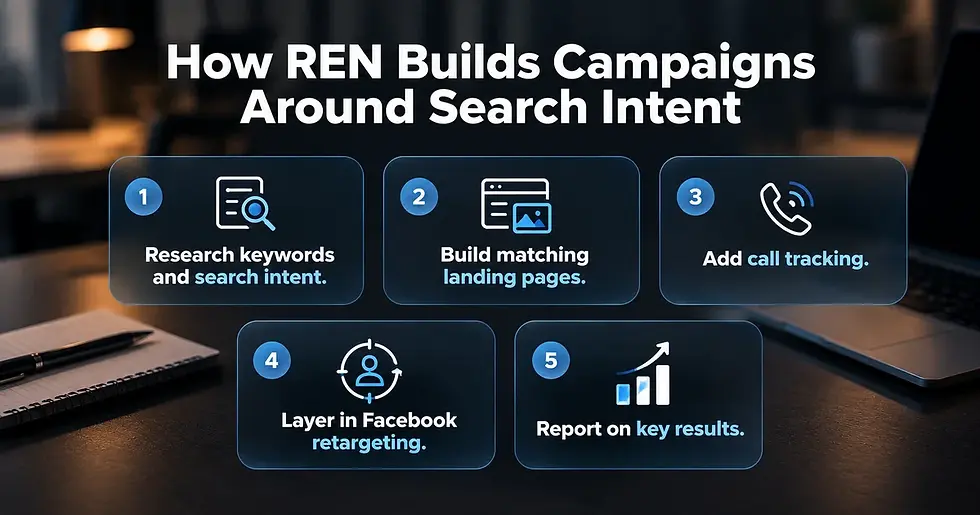
We're a Google Partner agency, which means we've met Google's own standards for campaign management and client results. That certification isn't decoration. It shapes how we build every account.
Here's our approach for window covering marketing services:
Start with keyword and intent research. We map exactly what your local buyers are searching, down to specific product terms like "cellular shades" or "motorized blinds."
Build landing pages that match the search. A generic homepage doesn't convert search traffic. We've designed over 200 landing pages built specifically to match ad intent.
Layer in call tracking. Since most local service leads come by phone, every campaign includes call tracking so you know which ad drove which booked estimate.
Add Facebook retargeting on top. Once Google is driving qualified traffic, we retarget those visitors on Facebook with visual before-and-after creative to bring back the ones who didn't call right away.
Report on what matters. Booked consultations and closed sales, not clicks and impressions.
We've applied this exact process across window covering clients nationwide, part of the 150,000-plus leads and 1,000-plus ad creatives we've built across our client base.
Want this built for you? Already spending on ads but not seeing booked estimates? A window treatment advertising agency that specializes in this industry can rebuild your account structure in days, not months. |
Conclusion
Google Ads wins for window treatment companies because it meets buyers at the exact moment they're ready to act, not while they're scrolling past photos of someone else's living room. That intent translates into faster bookings, better close rates, and phone calls you can actually track back to ad spend.
Facebook still has a role. Retargeting, visual storytelling, and staying visible between search sessions all matter. But if your budget is split evenly or leaning Facebook-heavy, you're probably leaving booked estimates on the table.
Whether you run a window covering business in Dallas, San Antonio, or anywhere in between, the fix usually starts with rebalancing where your dollars go first. Take a look at your last 90 days of ad spend. How many of those leads actually picked up the phone?
If the answer is fewer than you'd like, let's talk. Book a free strategy call and we'll show you exactly where your current campaigns are leaking budget.
FAQs
Is Google Ads better than Facebook Ads for window treatment companies?
For most window treatment companies, yes, because Google captures people already searching for blinds or shades installation. Facebook still has value for retargeting and visual brand building, but it typically shouldn't carry your primary lead budget.
How much does window treatment advertising cost per month?
Budgets vary by market size and competition, but most window covering companies we work with start with a combined Google and Facebook budget and adjust based on booked-estimate volume, not just click volume. We'll walk through specific numbers during a free strategy call.
How long does it take to see results from Google Ads?
Most window covering clients see qualified calls within the first one to two weeks, with campaigns fully optimized by day 30 to 45 as we gather enough data to refine targeting and landing pages.
Does REN Marketing offer window treatment advertising services in Dallas and San Antonio?
Yes. We run Google Ads, Facebook Ads, and landing page campaigns for window covering companies in both Dallas and San Antonio, along with markets across the country.
What makes REN different from a general marketing agency?
We specialize in home service and window covering lead generation specifically. As a Google Partner agency, we've built over 1,000 ad creatives and 200 landing pages, and we know the seasonal and buyer patterns unique to this industry.
Should I run Google Ads and Facebook Ads at the same time?
In most cases, yes. Google captures active buyers while Facebook retargets people who visited your site but didn't call yet. Running both together typically outperforms running either one alone.
Why do window covering companies get more phone calls from Google Ads than Facebook?
Because Google users are actively searching with intent to buy, while Facebook users are browsing. Combined with call tracking, Google Ads puts your number in front of someone at the exact moment they've decided to move forward.


